Tag

fintech

Browsing

How Crowdfunding Is Making the World a Better Place

Let us begin by telling you a tale.

Once upon a time, in the not-so-distant past (2008, to be precise), a young writer started a crowdfunding experiment called The Omikuji Project. She needed earnings to supplement her household income between novels and wanted to thank those supporting her budding career. So each month, she wrote a new story for paying subscribers. The Omikuji Project became “a unique way for you to read stories unavailable in any other venue, in any other way” and ran for five years.

Perhaps emboldened by her project’s outcome, she started a crowdfunded novel. New sections were added to her website every Monday and eager readers donated to read more.

That novel, The Girl Who Circumnavigated Fairyland in a Ship of Her Own Making, became the first online, crowdfunded book to win a major literary award: the Locus Andre Norton Award. It was also picked up for traditional publishing.

Catherynne M. Valente herself is now famous, with critical accolades and commercial success. Her work has made it to the New York Times bestseller and she has been nominated for the most prestigious science fiction and fantasy awards.

Let us continue by telling you a different tale.

Once upon a time, in the not-so-distant past (2009, to be precise), a crowdfunding project called Floating Doctors launched on the platform Kickstarter. The project was completely funded in less than a month.

Floating Doctors is a sea-faring medical group that provides free health care and medical supplies to needy communities in remote coastal regions. It is the brainchild of Dr. Benjamin LaBrot. He first came up with the concept after running out of supplies when treating villagers in Africa. He resolved to bring a bigger backpack next time. Today, LaBrot’s “backpack” is a sailboat named The Southern Wind, capable of carrying 20,000 pounds of medical supplies.

The Kickstarter campaign paid for The Southern Wind’s maiden voyage to Haiti in 2010. The money was used for the sailboat’s final prep, along with medical supplies and equipment. Today, Floating Doctors has expanded their mission to Honduras and Panama. Their operations are still currently running.

Witness the magic of crowdfunding. Many creative projects by promising yet unknown artists were born thanks to this mode of alternative financing. Crowdfunding has also funneled funds to social causes and charities.

Here at Funding Societies, we have translated the concept into a peer-to-peer lending platform meant to help grow and strengthen local Small and Medium Enterprises (SMEs). Did you know that according to The Singapore Department of Statistics, 99% of Singapore enterprises are SMEs? SMEs are the backbone of our economy. And yet a Visa and Deloitte Digital SME Banking Study shows that four in ten SMEs in Singapore lack banking support – this despite a Singapore Business Federation National Business Survey that shows 72% of Singapore SMEs requires funds to better manage their working capital and aid cash flow.

Here at Funding Societies, we dream of achieving three goals: empowering SMEs, providing new investment opportunities in Singapore, and growing the economy.

This may sound like a fairy tale, some of you might think. Indeed, there is a touch of rags-to-riches in most success stories. Some stories are so breathtaking that one can get suspicious. Great. We are not here to tell you “let your guard down.” Be aware. Be sensible. Beware of fraud. These are good rules to keep in mind. Once crowdfunding, peer-to-peer lending, and alternative financing have better regulations, they will be easier to trust.

Let us end these tales simply.

Grounded in sound checks and balances, crowdfunding and alternative financing are forces for good. In fact, as evidenced by many examples, they are helping to make the world a better place.

So do your research, ask questions to your heart’s satisfaction, and start crowdfunding when the answers are positive. You’ll play a role in growing the arts, growing the community, and growing the economy.

Investing in a Post-US Election World

Prior to US Election Day 2016, most polls had projected a Hillary Clinton victory. So to say that the eventual result was unexpected seems fair. The shock impacted the markets even before the official winner was declared. As Donald Trump’s victory became more and more assured, gold prices soared; the metal is generally seen as a safe asset and a hedge against inflation. Meanwhile, emerging market stocks tumbled and the US dollar reached its highest point since 2003 post-election.

Investors are certainly reacting to the new President-elect’s campaign rhetoric, which is widely expected to culminate in more protectionist policies. Yet all the market fluctuations also reflect anxiety for the future. What will the future hold regarding long-term market stability? Will the markets continue on their volatile streak? Or will they calm after a while? And given all this financial uncertainty, what should the typical investor do?

One thing is clear: we need to prepare for a more unstable world. The best ways for investors to do so is by diversifying their portfolios, hunting for new investment opportunities, and staying calm.

Diversity Your Portfolio

Political events like the US presidential election tend to upset both the markets and investors’ confidence. Some investors have chosen to behave in a more conservative manner (see: the post-election demand for gold), while others have chosen to try and time the market in the middle of all this insecurity by pulling their assets and getting back in later when the markets stabilize.

But timing the market is a very risky affair, even for experts. If you want to fortify your portfolio in anxious times, you should diversify across different asset classes and rebalance your instruments periodically to maintain your risk profile.

Telling investors to diversify is very basic advice, but think about it. Diversifying your investments is something you can control in the midst of uncertainty. You get to choose which instruments to purchase and how much money you are comfortable allocating into each asset class.

The main idea here is to balance the potential for risk and reward. For example, if your portfolio consists of company stocks and precious metals, your stock value may have been erratic over the USA election season, but the value of your gold has gone up. As you can see, with a well-diversified portfolio, you remain in the clear if the stock markets fluctuate for the long-term, as your returns aren’t determined by the performance of a single asset class.

Don’t overload yourself with real-time market information, but do look at all asset classes and see how they will fit into your portfolio and your risk tolerance. The bottom line is: if your overall portfolio is doing fine, then geopolitical situations matter less.

This Is a Good Time to Hunt for New Investment Opportunities

If you feel like your investment portfolio is already well-balanced and you have covered the basics (such as fixed deposits, bonds, gold, and stocks), you can research new places to invest your money. There is an advantage to routinely looking at all the available options and seeing how they fit your portfolio because over time, asset classes produce different results. So to maintain your preferred risk profile, an investment portfolio needs periodic rebalancing.

If the current climate is rendering you a little skittish, you can try investing small sums into alternatives. Technology, for instance, can be a promising sector.

Internet stocks are obvious suspects. Think about how essential brands like Google have become. Yet some tech stocks, such as Facebook and Amazon, have taken a tumble post-election. Some observers opine that this stock slump is temporary, but note that unless you are an early investor in these tech companies, your returns won’t be spectacular. Also, if you already own company stocks in your portfolio, other areas in technology can answer the gap in your portfolio.

Innovative and profitable technology companies are not exclusive to Western markets. One technology-based investment opportunity that has arrived in Singapore is peer-to-peer lending, which utilizes online platforms to match borrowers and lenders. Borrowers take out a loan for working capital or other business necessities, while lenders who had collectively funded the loans earn interest-based earnings in return. Investing in peer-to-peer lending has several benefits: good return rates higher than deposits or bonds, a low entry barrier suitable for those wanting to try the business model first, and a streamlined online process. Despite being relatively new, a recent study by the UK Peer to Peer Finance Association (P2PFA) stated that so long as investors are educated and the regulatory framework is sound, peer-to-peer lending does not create systemic risk. In fact, borrower defaults would need to increase at least threefold to whittle down investor interest rates to below zero.

These days, certain apps can give you real-time updates on your favorite investments or even figure out the best investment mix for you. New opportunities are out there. Take the time to research and find new investments you can be confident in. Look for instruments with good growth that you can feel secure in.

Stay Calm and Don’t Make Rash Decisions

Yes, it can be difficult to enact this advice when your portfolio contains your hard-earned money, future hopes, and retirement plans. Investing can be as emotional as politics, making it difficult to stop watching the markets’ every move. Yet it is counterproductive to over analyze the current situation; there are too many variables. All the information overload can induce panic and cause you to “sell low, buy high” instead of the other way around. Additionally, don’t succumb to the temptation of making speculations. Impulsive decisions can change your portfolio drastically and at the moment, you need a balanced and stable portfolio.

***

Should you be interested in learning more about investing in peer-to-peer lending, click here. Funding Societies provides annual returns up to 14%, while maintaining rigorous credit assessment and utilizing escrow accounts for security of funds.

8 Things to Ask Yourself Before Applying for a Business Loan

These days, there are several resources available for business loans. But while the options exist, receiving funding is never easy – especially if you are part of a small business. Then there’s the evaluation bit. Lenders review your application thoroughly before they can deem you worthy and disburse the necessary funds. (For more information on the loan evaluation process, see this article).

Obviously, you want to maximize your chances of loan approval. Ask yourself these question before you prepare your loan application:

  1. Why do I need a business loan?

Every business loan consideration should start with this question. Do you really need a business loan? Of course, there are many excellent reasons why a business loan would be beneficial: you are planning an expansion and need financing to make it happen, you need to purchase equipment to improve your product, you need to purchase more inventory from your supplier, or you just need an injection of working capital.

Feeling unsure if your “why” passes the test? Here’s a good rule of thumb: ask yourself if a business loan will make your business grow. If the answer is yes, go for it. If not, you may want to evaluate some of your priorities.

Remember: whatever your reason for a business loan application, your lenders will question you about it. Be sure you can explain your reasoning eloquently.

  1. How much money do I need?

Like question number 1, lenders will ask loan applicants this question. Do ensure that you have spent enough time making proper calculations. If you are buying equipment, research the cost. Create financial projections.

Asking for too little will create working capital problems and might make your company financials suffer. Asking for too much makes you look as if you haven’t done the necessary research. Worse, lenders may think you lack credibility.

  1. How are my financials?

Obviously, your lenders will want to know if you can repay your loans. Otherwise why would they bother? So make sure you have a healthy cash flow and solid financial figures.

It’s very likely that you will be asked for your company’s balance sheets, income statements, cash flow statements, and bank statements so your lenders can analyze your situation.

Take the time to create accurate projections. Try to create a debt repayment plan as well.

  1. Do I have other debts?

Related to number 3, lenders will want to know all about your credit history. They want to ensure that you can repay your loan, and if you have other unmet obligations hanging over your head, lenders will view your other debts as a danger sign.

  1. Which lender is most appropriate for my credit needs?

Take the time to choose a lender that suits your needs. Research various loan products and structure, take a look at loan interest, etc. There are different lending institutions for different needs, such as large and small banks, financial institutions, government-backed loan packages, and alternative lenders, such as crowdfunding.

To read more about finding business financing for small businesses in Singapore, click here.

  1. Do I meet my chosen lender’s requirements?

Business loan applications goes both ways. While you need to choose the most suitable lender for you, it is crucial that you meet their requirements. Otherwise, sending a loan application would be a waste of time. And it can hurt you, because the next lender you apply to might question why you were rejected for other business loans.

  1. What’s my business plan?

Lenders will ask for your business plan. They want to know details on how you will use the loan money, what your plans for the future are, and whether you will ultimately repay your obligations.

A strong business plan should include past and current financial statements, along with future projections. Other elements you may want to consider are: company and product description, market analysis, and company strategy for growth.

  1. Do I have all my documents in order?

If you have all your documentation ready, the application process will be much smoother. You will also look prepared to your lender.

While required documents vary across different lending institutions, every lender will ask for financial statements. In addition, you may be asked for your credit report (personal and/or business), tax returns, bank statements, collateral information (depending on loan type), and legal documents (business licenses and registrations, articles of incorporation, etc)

Ultimately, applying for a business loan is all about preparation. Good luck!

Investing in Invoice Financing vs. Investing in Term Loans

Some of our investors may have already heard of our new product: Invoice Financing. But perhaps some questions remain on why it is a worthy addition to our list of products, how it is different from our regular peer-to-peer loans, etc. We hope this post will alleviate and dispel any confusion.

To start, it may help to understand what invoice financing is and why a small business may need invoice financing. Invoice financing is a product where sellers (“Borrowers” in this case) sell the future receivables or invoices they issued to their customers (“Debtors”) to get immediate cash, at a discount. When the debtors pay their invoices, investors who bought these future receivables would receive full payment and make a return.

A small business, no matter how profitable or healthy, needs constant cash flow. Credit terms of invoices (usually between 30 to 90 days) result in a time gap between delivery of goods/services and receipt of payment. Invoice financing bridges this gap by providing immediate cash up front. Certain businesses need running cash flow more than others. Wholesalers are a good example – they always need to buy more stock inventory. If most of their income is in accounts receivable, then their cash cycle will be negatively impacted.

Compare invoice financing to the more ubiquitous term loan. Invoice financing and term loans have visibly different tenures. Our term loans’ tenures range between 3 to 24 months whilst terms of payment (i.e. tenure) for invoice financing listings range between 30 and 90 days, typical of invoice cycles – this is a great difference, and some investors are fond of invoice financing because it takes much less time to get their full principal and interest back.

Another key difference would be the risks involved. As invoice financing listings are secured against the invoices, lesser risk is involved. Furthermore, an invoice financing institution would not advance 100% of the borrower’s invoice to buffer against any unforeseen circumstances. This reserve amount (as we call it), will push the Seller to chase the Debtor for timely repayments as any borrower woul want 100% of his invoice back rather than 80% the maximum amount Funding Societies will advance payment for.

The repayment and fee structures differ between the two products as well. For term loans, repayments are on a monthly basis, while service fees are charged at 1% of the monthly repayment. For invoice financing listings, repayments are only made on the invoice due date, while service fees are charged at 15% of the interest earned.

Of course, certain things stay the same here at Funding Societies. Our credit assessment of borrowers will remain rigorous. In fact, for invoice financing listings, we’ll extend our assessments to the debtors as well. We will continue with our monthly reminders and strong infrastructure in place to collect repayments in case of payment delays. As per term loans, for each invoice financing listing we put up, investors have access to a detailed factsheet to evaluate the listing.

The returns you can earn from invoice financing is comparable to term loans as well, at around 8% to 15% per annum. So if you are interested in investing in our new product, click here to access your “Browse Loans” page if you already have an account with us. If you don’t, click here to sign up now!

How Invoice Financing Can Help Business Owners

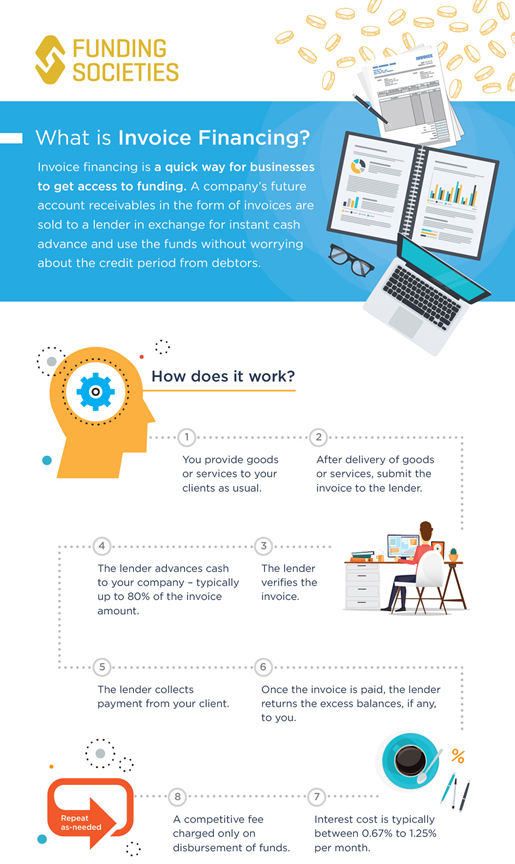
Funding Societies is happy to announce the launch of our newest product: Invoice Financing. As an introduction, invoice financing is a product where sellers (“Borrowers” in this case) sell the future receivables or invoices they issued to their customers (“Debtors”) to get immediate cash.

Simplifying the concept further, say there is a business owner and a buyer. The buyer purchased goods or services from the business owner and was issued an invoice with a credit term of 60 days. This means the business owner will only receive payment after 60 days, at the earliest; but what if the business owner needs immediate cash? This is where invoice financing comes in. Business owners can sell their invoices at a discount, in exchange for immediate cash, thus enhancing cash flow.

Utilised wisely, invoice financing can be a fantastic tool for business owners. The process of getting upfront cash through invoice financing is significantly quicker than applying for a loan from a traditional financial institution. This is especially useful for business owners who need a quick cash flow fix. Perhaps he has the opportunity to fund business growth but most of his short-term assets are tied up in accounts receivables – he can apply for invoice financing and does not have to wait till the end of the credit term to get cash.

Here at Funding Societies, we can advance an immediate loan of up to 80% of the invoice value at interest rates as low as 0.67% a month. We charge no processing fee for the loan application and approval process, only a competitive fee upon successful disbursement.

For first time Funding Societies borrowers, it would take three to seven business days from application to disbursement – a process that is relatively quick and already includes a compliance check. Repeat borrowers are in luck: the assessment, approval, and disbursement process takes merely one to two business days.

Interested in learning more about our invoice financing product? Refer to our infographic below, or contact us to find out more!

My Greatest Takeaways From the 12-week Internship at Funding Societies

Everyone dreams of finding a job they love. Like many other undergraduates, I spent several summer breaks in various internships, letting each experience guide me in discovery of my passion. This phase of gaining work experience helped me develop particular interests in two areas – Enterprise development and Financial Services. That was why I was exhilarated when I came across Funding Societies’ internship advertisement through NUS career centre newsletter. It was described as aFinTech platform which aims to help SMEs grow through Peer-to-Peer (P2P) crowdlending.

At that moment, I had no idea what P2P meant, or what exactly ‘FinTech’ was all about. However, I was intrigued enough to want to delve deeper.

My encounter with Funding Societies has been extraordinary from the very beginning. The interviewer and I had an equal share of time to introduce ourselves. Unlike other interviews where candidates are selected by the hiring manager unilaterally, the balanced two-way communication gave me opportunities to discern whether we would be great fit for each other.

I learned that I was being offered to join Funding Societies as the first ever intern! The past 3 months with Funding Societies have been full of magical moments and learning experiences. Here are some of my greatest takeaways

  1. All initiatives are encouraged, even the crazy ones

At Funding Societies, I am given as much autonomy as everyone else in the company although I am ‘just’ an intern. I am constantly encouraged to input my opinions, feedback and suggestions. While discussing about improving productivity, someone casually proposed moving our weekly sharing sessions from Monday morning to Friday just because – Monday Blues, and it actually happened! Such open culture allows me to become more and more comfortable in speaking up. I find this an enjoyable process because even the most ridiculous-sounding ideas are taken seriously and discussed thoroughly before deciding whether to be implemented (Stay tuned to learn more as we roll these out!). Having the power of choosing what I want to work on also means work is never boring!

  1. Challenge yourself constantly

I got to be part of the competitive and fast-paced start-up scene. New competition emerges every other day and the only way to thrive is to move faster than anyone else. Allocating the limited resources with most efficiency is critical. Freedom and autonomy come with a strong dose of responsibility, and this period has been a test of my discipline in time management. I am constantly challenged to reach my maximum potential. I have always believed that a fulfilling career isn’t a destination but a journey. Hence, it’s important to grow together with the company, and Funding Societies is giving me this remarkable experience.

  1. Your work matters – a lot

At Funding Societies, any work done on each day serves an immediate purpose. I was involved in meaningful projects that are crucial to the company and saw it through from planning to implementation. No words can describe the sense of pride and achievement of seeing my work published on the website for the first time. I enjoy interacting with our clients through our chat feature on the website because I know our conversations have a direct impact on their actions, and often results in Funding Societies gaining new borrowers or investors. I am inspired to take ownership of my work and continuously strive towards providing the best experience to all Funding Societies’ clients.

  1. Supportive team makes all the difference between good and great

Being surrounded by people who share the same goal and passion really brings about an amplified effect in productivity. I was pleasantly surprised to learn that all my colleagues, including the founders, would be willing to find time to respond to my queries no matter how busy they were. I was able to receive quick advice and feedback from managers with ample experiences and they have been of great help to me in getting my job done. If I am ever asked what I love most about Funding Societies, I will not hesitate in answering – ‘complete absence of office politics!’ I appreciate having the well-bonded team where difference of opinion can be resolved through a healthy discussion because I have seen in my previous workplaces how detrimental office politics are to work productivity and motivation. Here at FS, we are aligned in many ways to achieve progress and help one another grow.

  1. Earn solid returns on my investment

‘Skin-in-the-game’ philosophy is widely practiced at Funding Societies. This resonates with my personal beliefs the most. I know what I am working on has a positive impact on society and I am proud to be part of the solution. As such, I have started investing in our platform alongside other investors. I have been enjoying good returns so far and an exciting experience because I know that it means the funded SME is growing well enough to repay as well as investors’ money is deployed into efforts that not only result in stable returns, but make a difference in Singapore’s economy as well.

All in all, interning at Funding Societies for the past 12 weeks has been stimulating and satisfying, and the steep learning curve has enabled me to grow significantly as a motivated individual.

Shin Yiseul
NUS Year 4
Economics Major

How could you achieve 13-14% investment returns?

Article by Damon Wong

Dear investor,

Imagine you have some savings, so you’re looking to grow the money with a profitable business idea… But you don’t want to place your hard-earned money at risk by investing in the wrong things.
I know of an investment vehicle that is generating a double digit percentage growth for its investors… The best part?
The investor chooses how much and how long to invest in. And then it’s hands off until the time to pick up the check.
If you’re keen on making returns of 13%, riding on the wave of promising Singaporean businesses on their way up…
That’s where Funding Societies comes in.
They open doors to a selection of companies worthy of your investment. In fact, the performance of these companies is backed by research so you don’t have to do the heavy lifting…
As you read on, you will find out what Funding Societies is and how you can possibly achieve returns of 13-14% by investing with them.

1) What is Funding Societies?

Funding Societies is a peer-to-peer lending platform for retail investors like you and me to fund local businesses’ growth.
What’s unique about peer-to-peer lending, you may ask?
The main reason peer-to-peer lending is attractive to many… is the fact that it opens up investment opportunities to people like you and me.
It gives you access to investing in companies previously unavailable to the people – Companies (with huge growth and profit potential) that you’ll never have the chance to invest in… if not for the benefit that peer-to-peer lending provides you with.
And if you wish to invest in promising businesses that even expert investors are dying to get their hands on, getting a return of 13% on the investment while doing so… Then you must read on for how it may turn out to be the most feasible investment decision you make this year.
When investing, you want to keep risk at a manageable level. You want flexibility in the lock-down period that’s less than other instruments… So that when you plan for your expenses, you can look forward to seeing your money come back sooner.
As soon as 3 months should you wish.
Whether you’re looking to diversify a sizeable fund, or if you’re a retail investor with little ability to commit… you’re going to need different vehicles for your investment objectives.
Funding Societies enables investors like yourself to find the investment vehicle that matches your budget you set aside for growth.
Your investment in SMEs strengthen the backbone of our society. SMEs that make up 99% of all companies, SMEs that contribute up to 70% of the economy. By helping move the SMEs, you help move the economy…

2) Who Should Invest With Funding Societies?

a) Investors looking to diversify existing portfolio between short and mid term so they have the flexibility to get their money back whenever they choose;
b) Investors with limited funds but want to know exactly when the investment will mature, and how much to put in so they are always in control where their money goes;
c) Investors looking to make 13% returns on investment with a solid contingency plan in the event of defaulting payment, so they can sleep in peace at night;
d) Investors that support SMEs leading the culture of innovation, job creation, adding value to society, and at the same time growing their wealth with it.

3) How Safe Are My Investments With Funding Societies?

Funding Societies are offering a return of 13% on your investment. Regardless of how much you put in, you are in control of the exit period… Right from the start.
In fact, when you put your money down, an Escrow account managed by MAS registered Trust Agency holds on to it. What this means is that your money is in safe hands.
You can be currently invested in stocks, real estate, bonds… But Funding Societies provides you with an instrument that requires less lock-down time than any of the above, and is more stable than stocks. It lets you diversify your portfolio with better control over your risk and commitment.
Unlike some investments that require you to meet the broker at way-too-early o’clock to sign mountains of paperwork, Funding Societies makes it easier to grow your money by handling your transactions online. You can still do it in person should you wish, but the convenience of an online system is there.
You benefit from being an informed investor. Funding Society prepares and gathers both hard and soft data about the companies before you make an investment – a more comprehensive set of parameters than what banks do.

4) But What Are The Risks Involved?

You’re lending money to fund SME growth in Singapore. Behind every single company is a great mind and soul driven to make the business work.
Take it from our research done in interviewing owners.
With owners themselves being guarantors, they hold themselves and their businesses to high standards of accountability for you to invest confidently.
What this means is that when the companies you invest in close down, the owners have to pay you from their own pocket.
In the unlikely event of the SME defaulting, a collection agency steps in to recover the amount, giving you the right to pursue the matter legally.
This is the same collection agency that major banks in Singapore are using… Banks that have ATMs where probably withdrew your cash from earlier today. If they entrust this collection agency, you know you are in good hands to invest with confidence.

5) When Is A Good Time To Invest?

You heard of the saying that waiting for the best time to do something means never? But savvy investors recognize a good deal when they see one. Investors who make their investment before 31st Oct get their transaction fee waived.
Let me illustrate what is at stake here if you sat through this without doing anything.
Service fees are normally at 1%. For a $10000 investment, at 13% returns… That should put $1300 back in your pocket… But after service fee, that brings your earnings down to $1187.
You now have a chance for taking action, and for taking that action you now get to keep all of the earnings.
Back to $1300 of pure profit. The service fee is waived for your investment.
When SMEs that show great potential are identified, by 10000 other people reading this at the same time, some will be ready to take action…. You will want to secure the good companies to invest in before they get their funding and is no longer accepting anymore.

6) What Are Disadvantages To Investing With Funding Societies?

The disadvantage of investing with Funding Societies is that if you are currently holding on to a portfolio that’s giving you 25% returns from the stock market… Then this will not be beneficial for you at all.
Investing with Funding Societies currently offers returns of up to 13%… With a time period you can choose, and how much to invest that’s comfortable for your appetite.
So, if you find that you don’t want to take on huge risks when investing, and achieving returns of up to 13-14% sound reasonable to you…

Three Key Risks of Peer-to-Peer Lending

The Peer-to-Peer (P2P) lending sector has gained quite a fair bit of attention as financial services have taken greater heights in its innovation phase in Singapore. The P2P platforms, gaining most of the limelight, are Funding Societies, CapitalMatch and MoolahSense as they have collectively raised more than $10 million in 2015.

The returns provided by P2P outshine general investments and depository instruments such as index investing and fixed deposits.

However, what are the key risks involved in P2P lending and what proportion of our investment assets should consist of such instruments?

3 Key Risks In P2P Lending

#1 Risk of Default

P2P platforms link people with excess money (investors) to businesses that requires extra money in order to grow (borrowers). By doing so, investors would receive return, in the form of interest payments.

In simple terms, we should think of it as us lending money to a friend in need. It would be possible that this friend of ours will make timely repayments back to us, or that the person may not be able to repay the money they borrowed.

P2P lending is done in a more professional manner with contracts drafted, signed and with limiting factors included in the agreement. Nonetheless, the fundamentals are similar.

Although the rate of default is currently quite low, with only a few bad P2P loans at risk of defaulting , we should be more vigilant because this is a new financial space just blossomed in the last 1-2 years.

How we should assess the risk of default on the broader perspective, without dwelling into professional jargons, is to assume that all of these loans would have risk levels above the types of business loans done in Singapore.

The reason is simple, if banks in Singapore are not willing to lend to these businesses, it is largely due to (a) lack of historical information – business only operating for <1 year, (b) businesses that banks are unfamiliar with, (c) high risk businesses – trading firms, (d) businesses that are deemed non-viable and (e) businesses marginally failed to meet the extremely strict criteria set by our banks.

If we are able to stomach such risk, then we should we consider investing into P2P loans.


#2 P2P Platform Operation Standards and Vision

What we mostly read about P2P and its risk is largely associated with the risk of default by the businesses that we are investing (through lending).

What is equally important is the P2P platform, which plays the most important role in managing the risk of default since they are the ones assessing the businesses and deciding whether or not these businesses should be put through to their platform for funding.

We have to understand two key things (a) how the P2P platforms assess the businesses and (b) long term vision of the P2P platforms.

As for (a), understanding the P2P platforms’ methodology in assessing businesses is important because we want to understand how the P2P platform is looking at the business before deciding whether or not to provide the loan. Furthermore, it allows market participants to feedback so that they can improve as well.

For (b), the long-term vision of a P2P platform is also important information. Like all businesses, if a P2P platform intends to stay in the industry and be a market leader, they have to ensure that they are always competitive and are the best at what they do. The simplest way of being the market leader and excelling in this business is to reduce default rates to as near 0% as possible.


#3 Lack of Transparency

If there is one thing that keeps us up at night when it comes to P2P lending, it is the lack of transparency in the underlying businesses where the loan originates as well as the methodology in assessing businesses.


Lack of transparency in underlying business

When some P2P platform raises money for the businesses, they would put only the industry of which the business (e.g. wholesaler, design and build, etc.) is in. The name of the business is not provided.

For investors who invest a larger amount, it would make sense for them to do some background check to get a sense of the viability. However, without the sufficient disclosure, it would be impossible to do so.

Some P2P platforms do disclose the names of the businesses they lend to, but we believe this should be the norm, rather than the exception.

Lack of transparency in methodology

We do not doubt the ability of P2P platforms to assess the businesses via their methodology. That is because they have incentive to ensure that their methodoloy is as foolproof as possible. However, without any “request for comment” from professionals in the industry, it’s hard for the market to know how these methodology works. It also means that investors have to place 100% trust in the platform.


What is the proportion of assets that should be allocated to such instruments?

The 3 key risks mentioned should not turn you away from investing as the returns provided are significant, ranging from as low as 10% to over 20% per annum.

As mentioned, if we are able to stomach the risks, P2P lending is a great way to diversify our investment portfolio.

Nonetheless, we would not advocate allocating a large percentage of your total investment assets into P2P just yet. At least not until the P2P platforms start to reduce the lack of transparency issues mentioned above.


What Does UOB Investing In Peer-To-Peer Lending Platform Means For The Future Of Borrowing And Lending In Singapore

Just last week, UOB announced that they would be investing S$14 million into a global equity crowdfunding platform, OurCrowd.

For those who are not familiar with this type of lending, borrowing and funding, this is a relatively new type of peer-to-peer lending/funding, which in our opinion, would represent one of the key future of our banking industry.


What Is Peer-To-Peer Lending/Funding And Equity Crowding Funding?

To better understand how this industry works, let’s first review what commercial banks do.

One of the key functions of commercial banks like DBS, UOB and OCBC is to act as a financial intermediary between lenders and borrowers. Lenders represent people who have excess money, and who would like to keep their money in the bank account for safekeeping and to earn an interest. Borrowers represent those who are in need of funding. This could include companies such as Small Medium Enterprise (SMEs).

Instead of lending your money to a bank at a low interest rate, only for the bank to lend out the same money you gave them to an SME at a much higher interest rate, peer-to-peer (P2P) lending allows you to lend directly to the company that you want to lend it to, at a much higher interest rate than you would ever be able to attain from a bank.


Lending Money Vs Investing Money In Companies

DollarsAndSense.sg have been covering the P2P industry for some time and we understand that there are some differences in terms of the investing mechanism for investors. This can come in the form of equity and debt.


P2P Debt Lending:

P2P lending allows investors to lend money directly to borrowers. In Singapore, these borrowers are typically SMEs. We understand that for P2P lending platform such as Funding Societies, lenders can expect a return of about 12% – 16% per annum. Other platforms such as Capital Match also provide similar returns. Loan duration are usually about 6 months to 2 years.

From our discussion with these companies, we also understand that most of the borrowers accept onto their platform are established SMEs that have stable revenue. However, some of these companies may have insufficient credit history to be able to secure loans or credit lines from commercial banks. As such, they rely on P2P lending to help them with their short-term cashflow needs.

There is no question on the risk involved with P2P lending. The risk-return tradeoff theory states that you cannot expect higher returns without taking on a greater risk. When you lend to a commercial bank like UOB, the risk of you not getting your money back is extremely low which coincides with the extremely low returns you get. When you lend to an SME directly, there is a much greater risk of default that you bear in return for the high returns that you enjoy.

Read Also: How Peer-To-Peer Lending Can Help SMEs


What About P2P Equity CrowdFunding?

Think of equity crowdfunding as an episode of the Shark Tank or Dragons’ Den. Interested investors can purchase equity in a business of their choice as long as they are willing to meet the business owner’s asking price. In return, they get to enjoy the upside if the business performs well.

Common senses would suggest that P2P equity crowdfunding would be more risky than debt lending because there is no legal obligation for the money invested to be returned. In addition, companies that are willing to give up equity in return for investment are usually those in the start-up phase who still do not have a steady stream of revenue.


What UOB Investment Means For Personal Finance In Singapore

If this is your first time reading about P2P lending, it would be normal to feel slightly sceptical. People should never compare lending money to SMEs as the same thing as lending money to an established commercial bank like UOB.

However, the fact that UOB has invested money into an equity crowdfunding platform and intends to open it up to some of their valuable accredited UOB clients, it shows that the company is expanding its product range to suit its customer’s needs. These savvy investors are no longer satisfied to simply give their money to UOB and allow the banks to dictate where their money would go and the returns they should get.

Rather, they want to have choices and the banks are looking to provide their service by giving their clients these choices.

Safer Now Because Of The Endorsement Of Commercial Banks?

We want to debunk a myth before we conclude this article. Just because a local bank finally joined the P2P lending & funding scene, it does not make this sector any safer or riskier than it used to be. The risk exposure is similar as before.

The only thing it means is that the sector has now grown to a size that the local banks can no longer ignore. They either have to join in, or watch the boat sail by without them.

For a new sector like this, we think that by looking into the debt lending and being assured of a fixed return over a period of 6 months to 2 years is a lot safer than making equity investments into companies. Having said that, this is a sector where interested investors will need to go in well informed.

Read Also: 3 Reasons Why Peer-To-Peer Lending Should Be In Your Portfolio