Tag

fintech

Browsing

Is Your P2P Platform’s Interests Aligned With Yours?

Peer-to-Peer (P2P) lending platforms earn fees from matching borrowers with investors, but investors bear the full risk if loans default. Thus, it is important for investors to pay attention to the risks associated with the ‘originate and distribute’ model and look for lending platforms whose interests are aligned with investors.

Watch this video to find out how to check if the interests of platforms are aligned with investors:

Read also: 5 Things That You Can Learn From How Temasek Holdings Invests And Builds Its Portfolio

Find out more about the peer-to-peer loan at Funding Societies here.

Funding Societies is a DollarsAndSense Brand Connect partner. If you are interested to know them better, you can find out more on what they do on our DollarsAndSense Brand Connect Page.

Starter’s Guide: 6 Different Types Of Investments For You To Consider

If it is long-term financial security you are after, you will have to start investing – and better sooner than later. In this post, we will focus on the types of available. Major instruments include:

  1. Time deposits

A time deposit is a bank deposit with (i) a higher interest rate than a regular savings account, and (ii) a clear date of maturity. There are penalties for early withdrawals but once the account reaches maturity, you can withdraw funds without any fines. Or you can choose to leave your funds for another term. The longer you leave your money alone and the higher the amount of funds, the more interest you earn.

Time deposits are considered a low-risk, safe form of investment. It’s also easy to set up and is not complicated to grasp – so much so that time deposits are considered a beginner’s investment.

There are disadvantages, however. You can’t touch your funds during the term’s duration, so make sure you can afford to have your money locked away for the time being. Also, while a time deposit’s interest rate may be higher than a regular savings account, the same interest rate is lower than other types of investments and is in fact so low that time deposits’ rates often lose out to inflation rates.

  1. Precious Metals

Gold is a classic investment that remains popular throughout Asia. There are differing opinions on whether or not gold is still a viable investment. For your reference, we will include three varying arguments: from Investopedia, from CNN Money, and from the Daily Telegraph.

In general, gold and precious metals preserve wealth against rising inflation. For a long time, they have been considered safe investments during political and economic upheavals.

However, gold prices are actually very volatile. Also, gold pays its owner no income, unlike say, bonds or dividend stocks.

  1. Property

Property serves a similar function to gold: it is seen to preserve wealth against rising inflation. The value of property generally appreciates overtime, making property a popular long-term investment.

However, the main disadvantage of investing in property is glaringly obvious: entry cost is high. You need a lot of money to buy property. Additionally, property is not liquid and requires plenty of upkeep.

If you do have the resources to invest in property, you have options. You can hold on to your property and wait for its value to increase before selling it off for profit. Something else you can do is rent your property.

Renting your property is a great way to generate steady, passive income. However, you run the risk of ending up with a bad, destructive tenant. Or worse, no tenants.

  1. Bonds

When companies and governments need funds – perhaps to expand, perhaps to build infrastructure, they can choose not to borrow money from banks. Instead, they can issue bonds. Basically, bonds are a form of debt where a corporation/government is the borrower, while you – the bonds buyer – are the lender.

For example, if you buy a bond with a face value of $1000, an interest rate of 6%, and a maturity of five years – that means you’ll consistently receive $60 of interest per year for the next five years. When your bond matures after five years, your $1000 will be returned to you.

Bonds are lower-risk investment, but provide lower returns than, say, stocks. However, bonds’ fluctuations are also less dramatic than stocks. In addition, like time deposits and unlike gold, bonds provide a stable passive income.

  1. Stocks

Stocks are arguably the most well-known of all investments. Stocks are shares in the ownership of a company. When you own a company’s stocks, you have a claim on the company’s earnings – also called dividends. Stocks are popular for a reason: they offer higher returns than other instruments like bonds and time deposits. However, stocks are higher-risk investments, with prices rising and falling dramatically.

Ultimately, there are two types of stocks: dividend stocks and growth stocks. A growth stock is a stock in a quickly growing company. However, growth stocks pay back none of the company’s earnings as the growing company would rather use their earnings to expand their business. The only way you can make money from growth stocks is by selling off your stocks. Dividend stocks are the opposite. They pay stockholders part of the company’s earnings. The more dividend stocks you own, the larger your dividend portion.

While you can make money selling off excellent growth stocks, there is no guaranteed return. Meanwhile, dividend stocks replaces your income by paying you back in dividends. It all depends on your risk tolerance.

  1. Alternative Investments

Traditionally, alternative investments include investments that are not in the traditional forms of stocks, bonds, and cash assets. Artwork, antiques, and precious jewelry are all considered alternative investment.

Once upon a time, alternative investments were more intended for the wealthy. After all, you need money to build a painting or jewelry collection.

However, the status quo is changing thanks to the development of financial technology. Forms of alternative investments are increasing. A notable example is peer-to-peer lending.

Peer-to-peer lending platforms match investors and borrowers via digital technology. Borrowers get loans with competitive interest rates and investors are consistently paid back in installments.

Compared to other forms of alternative investments, the entry cost to investing in peer-to-peer lending is low. Like bonds and dividend stocks, peer-to-peer lending is a good source of passive income. While it does carry risk because borrowers can default, a good peer-to-peer lending platform will have performed the necessary due diligence.

Find out more about Alternative Investments through Funding Societies here.

Funding Societies is a DollarsAndSense Brand Connect partner. If you are interested to know them better, you can find out more on what they do on our DollarsAndSense Brand Connect Page.

What Is P2P Lending And How It Actually Works

The Peer-to-Peer (P2P) lending sector has gained quite a fair bit of attention as financial services have taken greater heights in its innovation phase in Singapore.

Read also: 3 Reasons Why Peer-To-Peer Lending Should Be In Your Portfolio

Whether you are an interested lender or borrower, it is important to note the pros and cons of P2P lending. Watch this video to find out more about P2P lending and how it actually works before considering it as part of your investment portfolio:

Read also: Three Key Risks Of Peer-To-Peer Lending

Find out more about the peer-to-peer loan at Funding Societies here.

Funding Societies is a DollarsAndSense Brand Connect partner. If you are interested to know them better, you can find out more on what they do on our DollarsAndSense Brand Connect Page.

The Myths and Misconceptions about Peer-to-Peer Lending

Over the past couple of years, peer-to-peer (P2P) lending has become an excellent alternative source of business financing, especially for SMEs and start-ups. With peer-to-peer lending, SMEs and start-ups can gain the funding they need for business development. Not only that, peer-to-peer lending is attractive to investors too, with its high returns and easy concept. However, with the rise of peer-to-peer lending, some myths have attached themselves to the concept. Want to separate fact and fiction? Here are some myths and misconceptions about peer-to-peer lending, along with the reality.

“You need a lot of money to get started”

False. In fact, one of peer-to-peer lending’s key advantages is its low entry barriers. Take our investment product, for example. With a S$1000 minimum first deposit at Funding Societies, you can start investing – and for better diversification, you can invest S$100 into ten loans each. You don’t need much to get started at all.

As a P2P investor, you also have flexibility as you are able to choose from the loans provided. You get to pick whichever loan has the tenor and interest rate that appeals to you most.

“It’s not a mainstream investment”

It depends on what you think of as “mainstream.” Yes, P2P lending as a concept has gained traction only recently, but there’s really nothing new about a business model where investors pool together the amount needed for a loan requested by a borrower. But these days, P2P lending activities are easier to facilitate thanks to online platforms and digital technology.

“There are no regulations for peer-to-peer lending”

One of the typical misconceptions about peer-to-peer lending is that the model is not yet regulated so investing in P2P lending or borrowing from a P2P platform can be risky. But it really depends on the region and country. In Singapore, MAS (Monetary Authority of Singapore) has issued a framework for the P2P lending model. Look for a local P2P lending platform that has been licensed!

“Peer-to-peer lending is crowdfunding”

Not really, but it’s easy to make the mistake. After all, peer-to-peer lending is a category of crowdfunding. Certain principles are the same, but there are a few differences between the two concepts. Crowdfunding pools resources from multiple individuals to gather financing for a particular project, perhaps a creative project or the creation of a product. Sometimes the individuals who help pitch in money for a crowdfunding campaign get rewarded with gifts and sometimes there are no physical rewards, similar to a donation.

Peer-to-peer lending, in the meantime, operates more like a lending and borrowing model. Investors and borrowers are connected through an online facilitator. Together, investors pool together finances for borrowers. The borrower will use the disbursed loan and repay his investors with interest.

“If you lend money on P2P platform, it will be locked for a fixed period”

Well, yes. A P2P investor is asked to commit funds for a fixed period, but for a shorter period than most other investments. On our platform, loan tenures range from 3 to 24 months, which compares favorably to other instruments.

We hope the above have dispelled some of the tangles and confusion. With its advantages, P2P lending is an attractive solution for both investor and borrowers. Do you agree?

Find out more about the peer-to-peer loan at Funding Societies here.

Funding Societies is a DollarsAndSense Brand Connect partner. If you are interested to know them better, you can find out more on what they do on our DollarsAndSense Brand Connect Page.

5 Steps for Better Cash Flow Management

Financing is the most important aspect of any business and smart entrepreneurs know that well-managed cash flow will prevent unnecessary costs and charges. Most business owners are aware of the importance of cash flow management, yet many have no idea how to do so. Whether you are a complete beginner or you want to get some more tips, read on for five steps to better cash flow management.

Read also: Growing Your Business Without Breaking The Bank

#1 Never expect quick payments

Have you ever had an experience when a customer did not pay you on time? It may not necessarily be because they are unable to pay the invoice. If your customer has ordered your product, it means that they are likely to have enough funds to pay for your goods. But unforeseen circumstances happen. Perhaps your customer has guidelines on extending payment terms. So it’s best never to expect quick payment on your sales. Instead, determine if you have enough working capital to keep your business running well in the event of payment delays. Remember the saying: hope for the best, but prepare for the worst.

#2 Read the details of your agreement

It’s rare to have a completely accurate invoicing process. However, understanding your customers’ payment processes or at least using the right purchase order numbers on every piece of communication can help you get paid on time. Carefully study the details of your payment agreement. Make sure you prepare everything you can so that your customers have no excuses to delay payment.

#3 Forecast your cash flow

Doing business without forecasting your cash flow is like driving a car in the rain without windscreen wipers: you can drive but you can’t see where you are going. Account for all expected incomes and expenses in the future.  Being aware of every completed transaction and updating your records accordingly can also help in managing your cash flow.

#4 Find the root of your cash flow problems

Analyze the root causes of your cash flow problem. Late payments are the most common cause of cash flow problems and financial mismanagement. You should also consider potential problems such as inaccurate invoicing, inconsistent pricing, lack of customer contact, or misunderstanding your customer’s payment cycles.

#5 Make use of technology

Ease your financing by using technology. Several software programs are available to help you manage your cash flow. This includes reminder notifications to help you ensure timely payment from your customers. Some software programs even help you to create consistent and professional invoices.

By having well-managed cash flow, you will be able to determine if you need financing support. Even beginners can improve cash flow management by simply incorporating these steps into their business practice. So, start working towards an optimised cash flow position today!

Find out more about the peer-to-peer loan at Funding Societies here.

Top Image

Funding Societies is a DollarsAndSense Brand Connect partner. If you are interested to know them better, you can find out more on what they do on our DollarsAndSense Brand Connect Page.

This New App Can Help You Kick Start Your Investment Journey

Peer-to-Peer (P2P) lending is growing part of investment portfolios in Singapore. This growing adoption is helped by FinTech companies like Funding Societies, which has a powerful yet easy-to-use platform that helps connect SMEs borrowers to a pool of willing lenders who lend them money in return for higher interest rates.

Read Also: 3 Reasons Why Peer-To-Peer Lending Should Be In Your Portfolio

For those new to P2P lending, check out this handy infographic:

Read Also: Three Key Risks of Peer-to-Peer Lending

As Singapore’s leading digital lending platform, Funding Societies provides P2P lending to SMEs in Singapore through an online marketplace, while giving individual investors the opportunity to lend your money for much higher returns.

In keeping with their goal to make investing easier and more accessible, Funding Societies has launched a mobile app so anyone can add P2P lending to their investment portfolio.

Through this app, you can check on upcoming investment opportunities as well as monitor the status of your portfolio wherever you are. If you’re not already a user of the Funding Societies platform, you can sign up and start investing from within the app.

The Funding Societies app is available on both iOS and Android devices. Do check it out and let us know what you think!

Funding Societies is a DollarsAndSense Brand Connect partner. If you are interested to know them better, you can find out more on what they do on our DollarsAndSense Brand Connect Page.


Top Image

Growing Your Business Without Breaking The Bank

Do you know that 99% of businesses in Singapore are small and medium-sized enterprises (SMEs)? They employ 7 out of every 10 workers and contribute over 50% towards the National GDP.

Yet only 1 in 20 SMEs gets bank financing. Why? Insufficient collateral and track record, staggering interest rates, or all of the above. The reality is that every business starts small and raising capital is a challenge. And in addition, startups are expected provide collateral, afford high interest rates, and have a proven track record, just to be able to get funded.

While traditional banks may be appropriate for big, established corporations, small businesses may be better served by a less traditional route, but one that has gained popularity and traction over recent years. Consider peer-to-peer (P2P) lending, also known as “social lending.” P2P lending allows for individuals to lend and borrow money directly from each other, doing away with the middlemen, financial intermediaries like banks. Just as it offers borrowers loans with low interest rates, P2P lending also benefits lenders (investors) with deserving returns.

How It Works

In a typical P2P lending scenario, you sign up to become a member at a P2P marketplace website. We at Funding Societies are among the first of such marketplace platforms in Singapore and South East Asia. Serving as the platform between borrower and lender, we take care of your borrowing and investment needs.

Borrowers

Before you can borrow from our pool of lenders, we first take some time to get to know you better. We look into business and credit records along with a personal interview to understand your business. Because we want to make sure everyone goes home happy, we only accept quality applications.

Let’s say you’ve been accepted (yay!). Our pool of lenders will see your approved application and make the decision to lend the funds to you. Once your loan is fully funded or funded to your satisfaction, the amount will be released to you.

Lenders

As a lender, you get to choose which ventures you wish to fund, and you can even spread your funds among several borrowers, spreading your risk. Because of the information transparency on our site, you’ll know what kind of business you’re lending to and to what end. You may sympathise with a particular industry’s story or venture, and the future success of the borrower and related industry can give you a sense of personal satisfaction knowing you contributed.

Getting Started

Whether you are a borrower or lender, you may look into P2P lending for your next venture and consider Funding Societies. We are a marketplace lending platform that facilitates funding objectives of SMEs who hit a roadblock when it comes to getting financing. From the borrower’s end, one business borrows from many lenders. From the lender’s end, one person lends to many small businesses, spreading and minimising risks. Investors or lenders get high returns (in comparison to most investment instruments) and borrowers get the loans they need at reasonable rates. And fast. All in all a win-win situation.

While we are confident in our mission, we realise that this operation comes with inherent risks and work with caution. In our efforts to mitigate any inherent or potential risks, we differentiate ourselves in that we work with a safer and less risky SME segment. With an interest rate of 10-20%, lenders can expect lower loan default. Being a marketplace platform, we are able to secure funds from not only retail investors, but also high net-worth individuals and institutional investors. From application to cash disbursement, the process time is short, with SMEs being able to immediately secure the minimum funding within days.

Our team is comprised of predominantly Southeast Asians, with a vision of making a positive contribution to the Southeast Asian societies, hence our name Funding Societies. Within three months since our incorporation in February 2015, we have put together a team of professionals, raised funds, and received large commitments from lenders. With access to the largest and most innovative marketplace lending players in the US and world-renowned thought leaders, and bringing into play the essence of the Silicon Valley startup culture, we work collectively to continually learn, deliver, and reinvent ourselves in this market.

Our customer service is rooted in our relationship with you. We are investing in our community and education to encourage discussion on relevant topics within the world of SMEs, safe borrowing, and investment, which is why you’ll see regular articles posted on our site blog. We have a dedicated team towards client service, ensuring that you will always be served and responded to in a timely way. Making the most of today’s technology, we operate efficiently to connect and facilitate the conversation among our community of borrowers and lenders (investors).

We understand that everybody starts somewhere, and it doesn’t matter where you are, our focus is to get you (the SMEs) the funding required to grow and for lenders (investors) the boost in returns you deserve. With your partnership, you’ll be helping us deliver our mission of serving local businesses and aspiring entrepreneurs. This is our social promise.

The thriving of our national economy is measured by the growth and success of its enterprises, small, medium, and big. Let’s work together not just for our individual accomplishments, but also for our collective progress as a community.

Read also: 8 Things to Ask Yourself Before Applying for a Business Loan

Find out more about the peer-to-peer loan at Funding Societies here.

One FinTech Company Hopes To Help SMEs Solve Cash Flow Challenges That Even Banks Have Problems With

SME and start-ups owners will be familiar with the challenge. Your business is doing perfectly fine but you need a short-term loan or a credit facility to tide over some cashflow matters.

You turn to your regular banks but are not familiar with the loans they are offering. They are covenants you need to adhere to, collaterals you need to put up for them, an existing credit history and other business documents that you may or may not have.

It’s a hassle and you only have two choice. Comply or walk away.

Funding Societies Bolt To Provide Fast And Secure Loans For SMEs

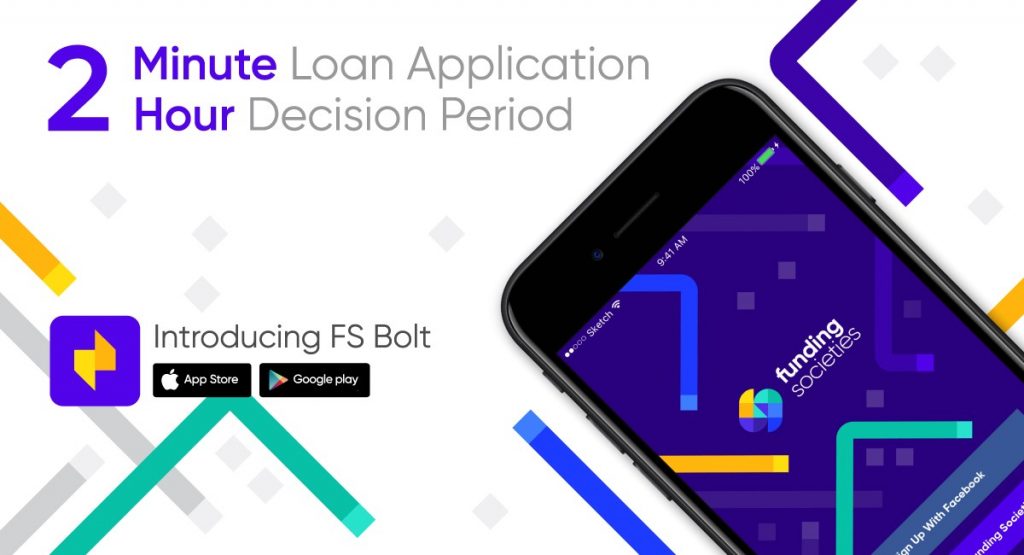
Local FinTech Company Funding Societies aims to solve this common headache of SME owners and fellow entrepreneurs by launching an app that allow users to apply for loans in just 2 minutes, through their mobile phone.

The app, called FS Bolt, is now available on both iOS and Android devices.

FS Bolt uses an automated credit assessment process that enables it to approve or reject loan application in just two hours. Once a loan has been approved, money will be disbursed within 24 hours of the loan application. This makes FS Bolt one of, if not, the quickest source of working capital loans that SMEs can tap upon in Singapore.

Read Also: 8 Things To Ask Yourself Before Applying For A Business Loan

Keeping It Flexible For Singapore’s SMEs

To keep it simple and flexible for SMEs, FS Bolt also provides loan tenor flexibility. Borrowers can repay their loan anytime they wish without incurring penalty for early repayment. This is a feature that many loan products in the market do not have. Such a feature provides incentives for borrowers to repay their loans quickly, with borrowers only paying the interest during the time the money was borrowed.

Different Products For Different Needs

Funding Societies is of course no stranger to supporting SMEs in Singapore. The company’s flagship product is its peer-to-peer (P2P) lending platform that helps connect SMEs borrowers to a pool of willing lenders who lend them money in return for higher interest rates.

The company has a rigorous credit assessment process and also practices what it calls “skin in the game” by having its founders and team investing alongside lenders in every crowdfunding opportunity.

Read Also: Three Key Risks Of Peer-To-Peer Lending

Choosing the Right Crowdfunding Product

Interested in raising capital through crowdfunding? We’re not surprised. After all, crowdfunding comes with some pretty sweet advantages. The crowdfunding process is cheap, quick, easy – often entirely online. Because crowdfunding requires no collateral, it is a great alternative to traditional funding such as secured loans.

As we discussed in our last article, there are three major forms of crowdfunding: rewards-based crowdfunding, equity crowdfunding, and peer-to-peer lending. To learn more about them and compare the different forms, click here.

Each form serves a different purpose and targets a different demographic, so it is crucial that you pick the right crowdfunding product. Which crowdfunding product is your match? Below, we have provided a handy list for you to use. Read on!

Rewards-Based Crowdfunding

  • Rewards-based crowdfunding is for you if you are trying to pitch a project. It is meant to raise capital for products or services. Its purpose is not to fund your overall business.
  • Rewards-based crowdfunding is ideal for those in the creative or artistic field, or those developing new products and technology to get market validation and pre-orders before starting production.
  • Most rewards-based crowdfunding campaigns expect to raise around $10,000 – $100,000 according to this article.
  • This is a crowdfunding form that requires effort on your part. You need to create a business plan for your brand and your project, you need to do research, think about legal and tax issues in advance, plan the rewards you will offer your supporters, and craft a compelling story or video to market your project and entice new backers. For more details, check out this Forbes article.
  • Costs include: reward and shipping costs, income taxes, and platform fees.
  • Key platforms include Kickstarter and Indiegogo. Coincidentally, Kickstarter has opened new branches in Asia, including Singapore.

Equity Crowdfunding

  • Equity crowdfunding’s primary purpose is to fund startups with strong growth potential.
  • Because equity crowdfunding is essentially a barter of company shares for funds, ask yourself: are you willing to part ways with your company shares? Are you someone who likes to be in control of your company? If you are indeed willing to let go of company stocks and are looking to raise a large amount of funds, then equity crowdfunding is for you.
  • Equity crowdfunding campaigns expect to raise somewhere between $250,000- $3,000,000.
  • Like rewards-based crowdfunding, equity crowdfunding requires effort on your part. Your startup may be very promising, but you still need to pitch its worth to potential investors on your chosen platform.
  • Costs include platform fees and of course, partial ownership of your business.
  • Key platforms include: AngelList and CircleUp.

Peer-to-Peer Lending or Debt Crowdfunding

  • Peer-to-peer lending provides loans with competitive rates and no collateral. Depending on your chosen platform, you can crowdfund personal loans or business loans.
  • However, peer-to-peer loans are especially useful for SMEs and the underbanked segment.
  • Ideal for small businesses searching for short-term credit to strengthen cash flow, to expand their companies, to finance a newly secured project, or just for operating expense.
  • Here’s an example: businesses with income tied in accounts receivable are a great target segment for peer-to-peer lending as they can have quick loans through invoice financing to start new projects while they wait to get paid.
  • A good option for younger, smaller, and revenue-generating companies, but with no suitable assets for secured loans.
  • Peer-to-peer lending campaigns expect to raise around $20,000-$500,000.
  • Requires less effort on your part compared to rewards-based crowdfunding and equity crowdfunding. Your chosen platform will do credit assessment to see if you are suitable for a loan and take care of the rest. You don’t need to market your funding needs.
  • Costs include platform fees and loan interest.

If peer-to-peer lending sounds like the crowdfunding product for you, you can learn more here and apply for a peer-to-peer loan at Funding Societies here.

The future of peer-to-peer lending in Asia

This article was first published by GTnews

The financial services industry has taken huge strides in the last 20-odd years, with path-breaking innovations in the financial system such as the advent of automated teller machines (ATMs), credit cards, online banking, mobile banking and sophisticated loan and deposit products. The speed of innovation has been unprecedented.

One new offering that has developed more recently is peer-to-peer (P2P) lending, also known as marketplace lending or crowdfunding. The concept seeks to leverage on the existing gaps in the lending system and serve the underbanked borrower segment while at the same time providing excellent returns to the lenders, who are usually retail investors with excess cash.

Since P2P lending is primarily an online proposition, the inherent costs and overheads are low. P2B (peer-to-business) lending seeks to use this concept to fund businesses which don’t have access to bank funding. Personal loans and loans to small businesses are the two most common lending products within the P2P framework.

The roots of P2P lending lie in the UK and US and go back to 2005-06, with lenders such as Zopa (the first P2P lender), Prosper, Lending Club and Ondeck being the pioneers. Thereafter came other big players like Funding Circle (UK) and Society One (Australia). Over the years, however, Asia has overtaken the US, primarily led by China. In 2015, P2P lenders globally originated loans worth US$64bn, with China contributing more than half of the total. Major lenders in Asia include:

China – Lufax, Dianrong, Yirendai
India – Faircent, Lenden Club, i2ifunding
Southeast Asia – Funding Societies, Modalku
Hong Kong – WeLab
Japan – Maneo

Unlike in the US and UK as well as some other developed markets, where P2P is predominantly an online model, a majority of the P2P lenders in Asia have a mix of online and offline models. Lack of data availability, low internet penetration, manual processes and regulatory challenges in emerging Asian economies are some of the challenges that inhibit growth of completely automated online models.

In the last few years, a new set of completely online P2P lenders has emerged. They use behavioural data from social media, acquire data through partnerships, and also use innovative technology-based credit scoring methods for giving out faster and lower-cost loans to underserved segments. One such example is Paipaidai in China which uses the online trading history of the borrower to underwrite loans.

Another recent phenomenon is the advent of cross-border P2P lending. Crowdcredit funds borrowers in emerging markets including Europe and Latin America through retail investors based in Japan.

The P2P segment has also attracted a significant amount of venture capital (VC) activity in recent times, as well as other funding, with some of the most notable funding for P2P lending companies in the Asian context including:

Lufax: Raised about US$19bn in their Series B round

Dianrong: Raised about US$1bn in their Series C round

WeLab: Raised U$160m in their Series B round

Funding Societies: Raised about US$7m in their Series A round

The key growth drivers for P2P lending in Asia include:

  • Rapidly-developing and high-growth Asian economies with large but credit-worthy underbanked populations
  • Huge funding gaps where banks are not able to lend due to structural inefficiencies
  • The availability of a large pool of retail investors with excess cash
  • Increasing internet and mobile phone penetration that complements the online product proposition and reach
  • Fintech-led fast online processes that help reduce costs and overheads while aiding customer adoption
  • Support from regulators and government bodies towards inclusive financial growth
  • According to Statista, P2P lending globally is expected to cross US$1 trillion in loan origination by 2050. Asia, given its unique positioning, should account for a significant portion of that total.