Tag

investment

Browsing

This New App Can Help You Kick Start Your Investment Journey

Peer-to-Peer (P2P) lending is growing part of investment portfolios in Singapore. This growing adoption is helped by FinTech companies like Funding Societies, which has a powerful yet easy-to-use platform that helps connect SMEs borrowers to a pool of willing lenders who lend them money in return for higher interest rates.

Read Also: 3 Reasons Why Peer-To-Peer Lending Should Be In Your Portfolio

For those new to P2P lending, check out this handy infographic:

Read Also: Three Key Risks of Peer-to-Peer Lending

As Singapore’s leading digital lending platform, Funding Societies provides P2P lending to SMEs in Singapore through an online marketplace, while giving individual investors the opportunity to lend your money for much higher returns.

In keeping with their goal to make investing easier and more accessible, Funding Societies has launched a mobile app so anyone can add P2P lending to their investment portfolio.

Through this app, you can check on upcoming investment opportunities as well as monitor the status of your portfolio wherever you are. If you’re not already a user of the Funding Societies platform, you can sign up and start investing from within the app.

The Funding Societies app is available on both iOS and Android devices. Do check it out and let us know what you think!

Funding Societies is a DollarsAndSense Brand Connect partner. If you are interested to know them better, you can find out more on what they do on our DollarsAndSense Brand Connect Page.

Top Image

Growing Your Business Without Breaking The Bank

Do you know that 99% of businesses in Singapore are small and medium-sized enterprises (SMEs)? They employ 7 out of every 10 workers and contribute over 50% towards the National GDP.

Yet only 1 in 20 SMEs gets bank financing. Why? Insufficient collateral and track record, staggering interest rates, or all of the above. The reality is that every business starts small and raising capital is a challenge. And in addition, startups are expected provide collateral, afford high interest rates, and have a proven track record, just to be able to get funded.

While traditional banks may be appropriate for big, established corporations, small businesses may be better served by a less traditional route, but one that has gained popularity and traction over recent years. Consider peer-to-peer (P2P) lending, also known as “social lending.” P2P lending allows for individuals to lend and borrow money directly from each other, doing away with the middlemen, financial intermediaries like banks. Just as it offers borrowers loans with low interest rates, P2P lending also benefits lenders (investors) with deserving returns.

How It Works

In a typical P2P lending scenario, you sign up to become a member at a P2P marketplace website. We at Funding Societies are among the first of such marketplace platforms in Singapore and South East Asia. Serving as the platform between borrower and lender, we take care of your borrowing and investment needs.

Borrowers

Before you can borrow from our pool of lenders, we first take some time to get to know you better. We look into business and credit records along with a personal interview to understand your business. Because we want to make sure everyone goes home happy, we only accept quality applications.

Let’s say you’ve been accepted (yay!). Our pool of lenders will see your approved application and make the decision to lend the funds to you. Once your loan is fully funded or funded to your satisfaction, the amount will be released to you.

Lenders

As a lender, you get to choose which ventures you wish to fund, and you can even spread your funds among several borrowers, spreading your risk. Because of the information transparency on our site, you’ll know what kind of business you’re lending to and to what end. You may sympathise with a particular industry’s story or venture, and the future success of the borrower and related industry can give you a sense of personal satisfaction knowing you contributed.

Getting Started

Whether you are a borrower or lender, you may look into P2P lending for your next venture and consider Funding Societies. We are a marketplace lending platform that facilitates funding objectives of SMEs who hit a roadblock when it comes to getting financing. From the borrower’s end, one business borrows from many lenders. From the lender’s end, one person lends to many small businesses, spreading and minimising risks. Investors or lenders get high returns (in comparison to most investment instruments) and borrowers get the loans they need at reasonable rates. And fast. All in all a win-win situation.

While we are confident in our mission, we realise that this operation comes with inherent risks and work with caution. In our efforts to mitigate any inherent or potential risks, we differentiate ourselves in that we work with a safer and less risky SME segment. With an interest rate of 10-20%, lenders can expect lower loan default. Being a marketplace platform, we are able to secure funds from not only retail investors, but also high net-worth individuals and institutional investors. From application to cash disbursement, the process time is short, with SMEs being able to immediately secure the minimum funding within days.

Our team is comprised of predominantly Southeast Asians, with a vision of making a positive contribution to the Southeast Asian societies, hence our name Funding Societies. Within three months since our incorporation in February 2015, we have put together a team of professionals, raised funds, and received large commitments from lenders. With access to the largest and most innovative marketplace lending players in the US and world-renowned thought leaders, and bringing into play the essence of the Silicon Valley startup culture, we work collectively to continually learn, deliver, and reinvent ourselves in this market.

Our customer service is rooted in our relationship with you. We are investing in our community and education to encourage discussion on relevant topics within the world of SMEs, safe borrowing, and investment, which is why you’ll see regular articles posted on our site blog. We have a dedicated team towards client service, ensuring that you will always be served and responded to in a timely way. Making the most of today’s technology, we operate efficiently to connect and facilitate the conversation among our community of borrowers and lenders (investors).

We understand that everybody starts somewhere, and it doesn’t matter where you are, our focus is to get you (the SMEs) the funding required to grow and for lenders (investors) the boost in returns you deserve. With your partnership, you’ll be helping us deliver our mission of serving local businesses and aspiring entrepreneurs. This is our social promise.

The thriving of our national economy is measured by the growth and success of its enterprises, small, medium, and big. Let’s work together not just for our individual accomplishments, but also for our collective progress as a community.

Read also: 8 Things to Ask Yourself Before Applying for a Business Loan

Find out more about the peer-to-peer loan at Funding Societies here.

One FinTech Company Hopes To Help SMEs Solve Cash Flow Challenges That Even Banks Have Problems With

SME and start-ups owners will be familiar with the challenge. Your business is doing perfectly fine but you need a short-term loan or a credit facility to tide over some cashflow matters.

You turn to your regular banks but are not familiar with the loans they are offering. They are covenants you need to adhere to, collaterals you need to put up for them, an existing credit history and other business documents that you may or may not have.

It’s a hassle and you only have two choice. Comply or walk away.

Funding Societies Bolt To Provide Fast And Secure Loans For SMEs

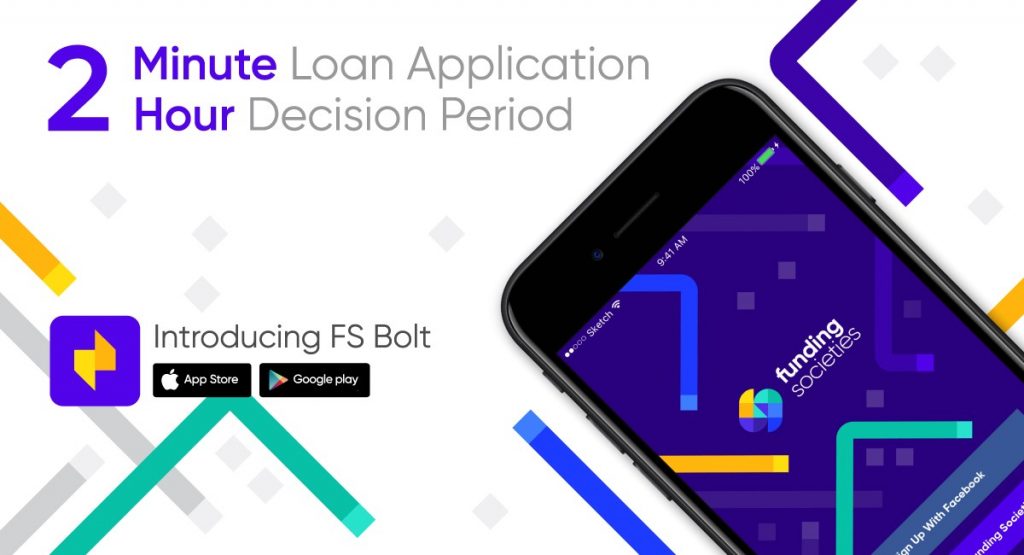
Local FinTech Company Funding Societies aims to solve this common headache of SME owners and fellow entrepreneurs by launching an app that allow users to apply for loans in just 2 minutes, through their mobile phone.

The app, called FS Bolt, is now available on both iOS and Android devices.

FS Bolt uses an automated credit assessment process that enables it to approve or reject loan application in just two hours. Once a loan has been approved, money will be disbursed within 24 hours of the loan application. This makes FS Bolt one of, if not, the quickest source of working capital loans that SMEs can tap upon in Singapore.

Read Also: 8 Things To Ask Yourself Before Applying For A Business Loan

Keeping It Flexible For Singapore’s SMEs

To keep it simple and flexible for SMEs, FS Bolt also provides loan tenor flexibility. Borrowers can repay their loan anytime they wish without incurring penalty for early repayment. This is a feature that many loan products in the market do not have. Such a feature provides incentives for borrowers to repay their loans quickly, with borrowers only paying the interest during the time the money was borrowed.

Different Products For Different Needs

Funding Societies is of course no stranger to supporting SMEs in Singapore. The company’s flagship product is its peer-to-peer (P2P) lending platform that helps connect SMEs borrowers to a pool of willing lenders who lend them money in return for higher interest rates.

The company has a rigorous credit assessment process and also practices what it calls “skin in the game” by having its founders and team investing alongside lenders in every crowdfunding opportunity.

Read Also: Three Key Risks Of Peer-To-Peer Lending

Choosing the Right Crowdfunding Product

Interested in raising capital through crowdfunding? We’re not surprised. After all, crowdfunding comes with some pretty sweet advantages. The crowdfunding process is cheap, quick, easy – often entirely online. Because crowdfunding requires no collateral, it is a great alternative to traditional funding such as secured loans.

As we discussed in our last article, there are three major forms of crowdfunding: rewards-based crowdfunding, equity crowdfunding, and peer-to-peer lending. To learn more about them and compare the different forms, click here.

Each form serves a different purpose and targets a different demographic, so it is crucial that you pick the right crowdfunding product. Which crowdfunding product is your match? Below, we have provided a handy list for you to use. Read on!

Rewards-Based Crowdfunding

  • Rewards-based crowdfunding is for you if you are trying to pitch a project. It is meant to raise capital for products or services. Its purpose is not to fund your overall business.
  • Rewards-based crowdfunding is ideal for those in the creative or artistic field, or those developing new products and technology to get market validation and pre-orders before starting production.
  • Most rewards-based crowdfunding campaigns expect to raise around $10,000 – $100,000 according to this article.
  • This is a crowdfunding form that requires effort on your part. You need to create a business plan for your brand and your project, you need to do research, think about legal and tax issues in advance, plan the rewards you will offer your supporters, and craft a compelling story or video to market your project and entice new backers. For more details, check out this Forbes article.
  • Costs include: reward and shipping costs, income taxes, and platform fees.
  • Key platforms include Kickstarter and Indiegogo. Coincidentally, Kickstarter has opened new branches in Asia, including Singapore.

Equity Crowdfunding

  • Equity crowdfunding’s primary purpose is to fund startups with strong growth potential.
  • Because equity crowdfunding is essentially a barter of company shares for funds, ask yourself: are you willing to part ways with your company shares? Are you someone who likes to be in control of your company? If you are indeed willing to let go of company stocks and are looking to raise a large amount of funds, then equity crowdfunding is for you.
  • Equity crowdfunding campaigns expect to raise somewhere between $250,000- $3,000,000.
  • Like rewards-based crowdfunding, equity crowdfunding requires effort on your part. Your startup may be very promising, but you still need to pitch its worth to potential investors on your chosen platform.
  • Costs include platform fees and of course, partial ownership of your business.
  • Key platforms include: AngelList and CircleUp.

Peer-to-Peer Lending or Debt Crowdfunding

  • Peer-to-peer lending provides loans with competitive rates and no collateral. Depending on your chosen platform, you can crowdfund personal loans or business loans.
  • However, peer-to-peer loans are especially useful for SMEs and the underbanked segment.
  • Ideal for small businesses searching for short-term credit to strengthen cash flow, to expand their companies, to finance a newly secured project, or just for operating expense.
  • Here’s an example: businesses with income tied in accounts receivable are a great target segment for peer-to-peer lending as they can have quick loans through invoice financing to start new projects while they wait to get paid.
  • A good option for younger, smaller, and revenue-generating companies, but with no suitable assets for secured loans.
  • Peer-to-peer lending campaigns expect to raise around $20,000-$500,000.
  • Requires less effort on your part compared to rewards-based crowdfunding and equity crowdfunding. Your chosen platform will do credit assessment to see if you are suitable for a loan and take care of the rest. You don’t need to market your funding needs.
  • Costs include platform fees and loan interest.

If peer-to-peer lending sounds like the crowdfunding product for you, you can learn more here and apply for a peer-to-peer loan at Funding Societies here.

The future of peer-to-peer lending in Asia

This article was first published by GTnews

The financial services industry has taken huge strides in the last 20-odd years, with path-breaking innovations in the financial system such as the advent of automated teller machines (ATMs), credit cards, online banking, mobile banking and sophisticated loan and deposit products. The speed of innovation has been unprecedented.

One new offering that has developed more recently is peer-to-peer (P2P) lending, also known as marketplace lending or crowdfunding. The concept seeks to leverage on the existing gaps in the lending system and serve the underbanked borrower segment while at the same time providing excellent returns to the lenders, who are usually retail investors with excess cash.

Since P2P lending is primarily an online proposition, the inherent costs and overheads are low. P2B (peer-to-business) lending seeks to use this concept to fund businesses which don’t have access to bank funding. Personal loans and loans to small businesses are the two most common lending products within the P2P framework.

The roots of P2P lending lie in the UK and US and go back to 2005-06, with lenders such as Zopa (the first P2P lender), Prosper, Lending Club and Ondeck being the pioneers. Thereafter came other big players like Funding Circle (UK) and Society One (Australia). Over the years, however, Asia has overtaken the US, primarily led by China. In 2015, P2P lenders globally originated loans worth US$64bn, with China contributing more than half of the total. Major lenders in Asia include:

China – Lufax, Dianrong, Yirendai
India – Faircent, Lenden Club, i2ifunding
Southeast Asia – Funding Societies, Modalku
Hong Kong – WeLab
Japan – Maneo

Unlike in the US and UK as well as some other developed markets, where P2P is predominantly an online model, a majority of the P2P lenders in Asia have a mix of online and offline models. Lack of data availability, low internet penetration, manual processes and regulatory challenges in emerging Asian economies are some of the challenges that inhibit growth of completely automated online models.

In the last few years, a new set of completely online P2P lenders has emerged. They use behavioural data from social media, acquire data through partnerships, and also use innovative technology-based credit scoring methods for giving out faster and lower-cost loans to underserved segments. One such example is Paipaidai in China which uses the online trading history of the borrower to underwrite loans.

Another recent phenomenon is the advent of cross-border P2P lending. Crowdcredit funds borrowers in emerging markets including Europe and Latin America through retail investors based in Japan.

The P2P segment has also attracted a significant amount of venture capital (VC) activity in recent times, as well as other funding, with some of the most notable funding for P2P lending companies in the Asian context including:

Lufax: Raised about US$19bn in their Series B round

Dianrong: Raised about US$1bn in their Series C round

WeLab: Raised U$160m in their Series B round

Funding Societies: Raised about US$7m in their Series A round

The key growth drivers for P2P lending in Asia include:

  • Rapidly-developing and high-growth Asian economies with large but credit-worthy underbanked populations
  • Huge funding gaps where banks are not able to lend due to structural inefficiencies
  • The availability of a large pool of retail investors with excess cash
  • Increasing internet and mobile phone penetration that complements the online product proposition and reach
  • Fintech-led fast online processes that help reduce costs and overheads while aiding customer adoption
  • Support from regulators and government bodies towards inclusive financial growth
  • According to Statista, P2P lending globally is expected to cross US$1 trillion in loan origination by 2050. Asia, given its unique positioning, should account for a significant portion of that total.

How Crowdfunding Is Making the World a Better Place

Let us begin by telling you a tale.

Once upon a time, in the not-so-distant past (2008, to be precise), a young writer started a crowdfunding experiment called The Omikuji Project. She needed earnings to supplement her household income between novels and wanted to thank those supporting her budding career. So each month, she wrote a new story for paying subscribers. The Omikuji Project became “a unique way for you to read stories unavailable in any other venue, in any other way” and ran for five years.

Perhaps emboldened by her project’s outcome, she started a crowdfunded novel. New sections were added to her website every Monday and eager readers donated to read more.

That novel, The Girl Who Circumnavigated Fairyland in a Ship of Her Own Making, became the first online, crowdfunded book to win a major literary award: the Locus Andre Norton Award. It was also picked up for traditional publishing.

Catherynne M. Valente herself is now famous, with critical accolades and commercial success. Her work has made it to the New York Times bestseller and she has been nominated for the most prestigious science fiction and fantasy awards.

Let us continue by telling you a different tale.

Once upon a time, in the not-so-distant past (2009, to be precise), a crowdfunding project called Floating Doctors launched on the platform Kickstarter. The project was completely funded in less than a month.

Floating Doctors is a sea-faring medical group that provides free health care and medical supplies to needy communities in remote coastal regions. It is the brainchild of Dr. Benjamin LaBrot. He first came up with the concept after running out of supplies when treating villagers in Africa. He resolved to bring a bigger backpack next time. Today, LaBrot’s “backpack” is a sailboat named The Southern Wind, capable of carrying 20,000 pounds of medical supplies.

The Kickstarter campaign paid for The Southern Wind’s maiden voyage to Haiti in 2010. The money was used for the sailboat’s final prep, along with medical supplies and equipment. Today, Floating Doctors has expanded their mission to Honduras and Panama. Their operations are still currently running.

Witness the magic of crowdfunding. Many creative projects by promising yet unknown artists were born thanks to this mode of alternative financing. Crowdfunding has also funneled funds to social causes and charities.

Here at Funding Societies, we have translated the concept into a peer-to-peer lending platform meant to help grow and strengthen local Small and Medium Enterprises (SMEs). Did you know that according to The Singapore Department of Statistics, 99% of Singapore enterprises are SMEs? SMEs are the backbone of our economy. And yet a Visa and Deloitte Digital SME Banking Study shows that four in ten SMEs in Singapore lack banking support – this despite a Singapore Business Federation National Business Survey that shows 72% of Singapore SMEs requires funds to better manage their working capital and aid cash flow.

Here at Funding Societies, we dream of achieving three goals: empowering SMEs, providing new investment opportunities in Singapore, and growing the economy.

This may sound like a fairy tale, some of you might think. Indeed, there is a touch of rags-to-riches in most success stories. Some stories are so breathtaking that one can get suspicious. Great. We are not here to tell you “let your guard down.” Be aware. Be sensible. Beware of fraud. These are good rules to keep in mind. Once crowdfunding, peer-to-peer lending, and alternative financing have better regulations, they will be easier to trust.

Let us end these tales simply.

Grounded in sound checks and balances, crowdfunding and alternative financing are forces for good. In fact, as evidenced by many examples, they are helping to make the world a better place.

So do your research, ask questions to your heart’s satisfaction, and start crowdfunding when the answers are positive. You’ll play a role in growing the arts, growing the community, and growing the economy.

Investing in a Post-US Election World

Prior to US Election Day 2016, most polls had projected a Hillary Clinton victory. So to say that the eventual result was unexpected seems fair. The shock impacted the markets even before the official winner was declared. As Donald Trump’s victory became more and more assured, gold prices soared; the metal is generally seen as a safe asset and a hedge against inflation. Meanwhile, emerging market stocks tumbled and the US dollar reached its highest point since 2003 post-election.

Investors are certainly reacting to the new President-elect’s campaign rhetoric, which is widely expected to culminate in more protectionist policies. Yet all the market fluctuations also reflect anxiety for the future. What will the future hold regarding long-term market stability? Will the markets continue on their volatile streak? Or will they calm after a while? And given all this financial uncertainty, what should the typical investor do?

One thing is clear: we need to prepare for a more unstable world. The best ways for investors to do so is by diversifying their portfolios, hunting for new investment opportunities, and staying calm.

Diversity Your Portfolio

Political events like the US presidential election tend to upset both the markets and investors’ confidence. Some investors have chosen to behave in a more conservative manner (see: the post-election demand for gold), while others have chosen to try and time the market in the middle of all this insecurity by pulling their assets and getting back in later when the markets stabilize.

But timing the market is a very risky affair, even for experts. If you want to fortify your portfolio in anxious times, you should diversify across different asset classes and rebalance your instruments periodically to maintain your risk profile.

Telling investors to diversify is very basic advice, but think about it. Diversifying your investments is something you can control in the midst of uncertainty. You get to choose which instruments to purchase and how much money you are comfortable allocating into each asset class.

The main idea here is to balance the potential for risk and reward. For example, if your portfolio consists of company stocks and precious metals, your stock value may have been erratic over the USA election season, but the value of your gold has gone up. As you can see, with a well-diversified portfolio, you remain in the clear if the stock markets fluctuate for the long-term, as your returns aren’t determined by the performance of a single asset class.

Don’t overload yourself with real-time market information, but do look at all asset classes and see how they will fit into your portfolio and your risk tolerance. The bottom line is: if your overall portfolio is doing fine, then geopolitical situations matter less.

This Is a Good Time to Hunt for New Investment Opportunities

If you feel like your investment portfolio is already well-balanced and you have covered the basics (such as fixed deposits, bonds, gold, and stocks), you can research new places to invest your money. There is an advantage to routinely looking at all the available options and seeing how they fit your portfolio because over time, asset classes produce different results. So to maintain your preferred risk profile, an investment portfolio needs periodic rebalancing.

If the current climate is rendering you a little skittish, you can try investing small sums into alternatives. Technology, for instance, can be a promising sector.

Internet stocks are obvious suspects. Think about how essential brands like Google have become. Yet some tech stocks, such as Facebook and Amazon, have taken a tumble post-election. Some observers opine that this stock slump is temporary, but note that unless you are an early investor in these tech companies, your returns won’t be spectacular. Also, if you already own company stocks in your portfolio, other areas in technology can answer the gap in your portfolio.

Innovative and profitable technology companies are not exclusive to Western markets. One technology-based investment opportunity that has arrived in Singapore is peer-to-peer lending, which utilizes online platforms to match borrowers and lenders. Borrowers take out a loan for working capital or other business necessities, while lenders who had collectively funded the loans earn interest-based earnings in return. Investing in peer-to-peer lending has several benefits: good return rates higher than deposits or bonds, a low entry barrier suitable for those wanting to try the business model first, and a streamlined online process. Despite being relatively new, a recent study by the UK Peer to Peer Finance Association (P2PFA) stated that so long as investors are educated and the regulatory framework is sound, peer-to-peer lending does not create systemic risk. In fact, borrower defaults would need to increase at least threefold to whittle down investor interest rates to below zero.

These days, certain apps can give you real-time updates on your favorite investments or even figure out the best investment mix for you. New opportunities are out there. Take the time to research and find new investments you can be confident in. Look for instruments with good growth that you can feel secure in.

Stay Calm and Don’t Make Rash Decisions

Yes, it can be difficult to enact this advice when your portfolio contains your hard-earned money, future hopes, and retirement plans. Investing can be as emotional as politics, making it difficult to stop watching the markets’ every move. Yet it is counterproductive to over analyze the current situation; there are too many variables. All the information overload can induce panic and cause you to “sell low, buy high” instead of the other way around. Additionally, don’t succumb to the temptation of making speculations. Impulsive decisions can change your portfolio drastically and at the moment, you need a balanced and stable portfolio.

***

Should you be interested in learning more about investing in peer-to-peer lending, click here. Funding Societies provides annual returns up to 14%, while maintaining rigorous credit assessment and utilizing escrow accounts for security of funds.

8 Things to Ask Yourself Before Applying for a Business Loan

These days, there are several resources available for business loans. But while the options exist, receiving funding is never easy – especially if you are part of a small business. Then there’s the evaluation bit. Lenders review your application thoroughly before they can deem you worthy and disburse the necessary funds. (For more information on the loan evaluation process, see this article).

Obviously, you want to maximize your chances of loan approval. Ask yourself these question before you prepare your loan application:

  1. Why do I need a business loan?

Every business loan consideration should start with this question. Do you really need a business loan? Of course, there are many excellent reasons why a business loan would be beneficial: you are planning an expansion and need financing to make it happen, you need to purchase equipment to improve your product, you need to purchase more inventory from your supplier, or you just need an injection of working capital.

Feeling unsure if your “why” passes the test? Here’s a good rule of thumb: ask yourself if a business loan will make your business grow. If the answer is yes, go for it. If not, you may want to evaluate some of your priorities.

Remember: whatever your reason for a business loan application, your lenders will question you about it. Be sure you can explain your reasoning eloquently.

  1. How much money do I need?

Like question number 1, lenders will ask loan applicants this question. Do ensure that you have spent enough time making proper calculations. If you are buying equipment, research the cost. Create financial projections.

Asking for too little will create working capital problems and might make your company financials suffer. Asking for too much makes you look as if you haven’t done the necessary research. Worse, lenders may think you lack credibility.

  1. How are my financials?

Obviously, your lenders will want to know if you can repay your loans. Otherwise why would they bother? So make sure you have a healthy cash flow and solid financial figures.

It’s very likely that you will be asked for your company’s balance sheets, income statements, cash flow statements, and bank statements so your lenders can analyze your situation.

Take the time to create accurate projections. Try to create a debt repayment plan as well.

  1. Do I have other debts?

Related to number 3, lenders will want to know all about your credit history. They want to ensure that you can repay your loan, and if you have other unmet obligations hanging over your head, lenders will view your other debts as a danger sign.

  1. Which lender is most appropriate for my credit needs?

Take the time to choose a lender that suits your needs. Research various loan products and structure, take a look at loan interest, etc. There are different lending institutions for different needs, such as large and small banks, financial institutions, government-backed loan packages, and alternative lenders, such as crowdfunding.

To read more about finding business financing for small businesses in Singapore, click here.

  1. Do I meet my chosen lender’s requirements?

Business loan applications goes both ways. While you need to choose the most suitable lender for you, it is crucial that you meet their requirements. Otherwise, sending a loan application would be a waste of time. And it can hurt you, because the next lender you apply to might question why you were rejected for other business loans.

  1. What’s my business plan?

Lenders will ask for your business plan. They want to know details on how you will use the loan money, what your plans for the future are, and whether you will ultimately repay your obligations.

A strong business plan should include past and current financial statements, along with future projections. Other elements you may want to consider are: company and product description, market analysis, and company strategy for growth.

  1. Do I have all my documents in order?

If you have all your documentation ready, the application process will be much smoother. You will also look prepared to your lender.

While required documents vary across different lending institutions, every lender will ask for financial statements. In addition, you may be asked for your credit report (personal and/or business), tax returns, bank statements, collateral information (depending on loan type), and legal documents (business licenses and registrations, articles of incorporation, etc)

Ultimately, applying for a business loan is all about preparation. Good luck!

Investing in Invoice Financing vs. Investing in Term Loans

Some of our investors may have already heard of our new product: Invoice Financing. But perhaps some questions remain on why it is a worthy addition to our list of products, how it is different from our regular peer-to-peer loans, etc. We hope this post will alleviate and dispel any confusion.

To start, it may help to understand what invoice financing is and why a small business may need invoice financing. Invoice financing is a product where sellers (“Borrowers” in this case) sell the future receivables or invoices they issued to their customers (“Debtors”) to get immediate cash, at a discount. When the debtors pay their invoices, investors who bought these future receivables would receive full payment and make a return.

A small business, no matter how profitable or healthy, needs constant cash flow. Credit terms of invoices (usually between 30 to 90 days) result in a time gap between delivery of goods/services and receipt of payment. Invoice financing bridges this gap by providing immediate cash up front. Certain businesses need running cash flow more than others. Wholesalers are a good example – they always need to buy more stock inventory. If most of their income is in accounts receivable, then their cash cycle will be negatively impacted.

Compare invoice financing to the more ubiquitous term loan. Invoice financing and term loans have visibly different tenures. Our term loans’ tenures range between 3 to 24 months whilst terms of payment (i.e. tenure) for invoice financing listings range between 30 and 90 days, typical of invoice cycles – this is a great difference, and some investors are fond of invoice financing because it takes much less time to get their full principal and interest back.

Another key difference would be the risks involved. As invoice financing listings are secured against the invoices, lesser risk is involved. Furthermore, an invoice financing institution would not advance 100% of the borrower’s invoice to buffer against any unforeseen circumstances. This reserve amount (as we call it), will push the Seller to chase the Debtor for timely repayments as any borrower woul want 100% of his invoice back rather than 80% the maximum amount Funding Societies will advance payment for.

The repayment and fee structures differ between the two products as well. For term loans, repayments are on a monthly basis, while service fees are charged at 1% of the monthly repayment. For invoice financing listings, repayments are only made on the invoice due date, while service fees are charged at 15% of the interest earned.

Of course, certain things stay the same here at Funding Societies. Our credit assessment of borrowers will remain rigorous. In fact, for invoice financing listings, we’ll extend our assessments to the debtors as well. We will continue with our monthly reminders and strong infrastructure in place to collect repayments in case of payment delays. As per term loans, for each invoice financing listing we put up, investors have access to a detailed factsheet to evaluate the listing.

The returns you can earn from invoice financing is comparable to term loans as well, at around 8% to 15% per annum. So if you are interested in investing in our new product, click here to access your “Browse Loans” page if you already have an account with us. If you don’t, click here to sign up now!

How Invoice Financing Can Help Business Owners

Funding Societies is happy to announce the launch of our newest product: Invoice Financing. As an introduction, invoice financing is a product where sellers (“Borrowers” in this case) sell the future receivables or invoices they issued to their customers (“Debtors”) to get immediate cash.

Simplifying the concept further, say there is a business owner and a buyer. The buyer purchased goods or services from the business owner and was issued an invoice with a credit term of 60 days. This means the business owner will only receive payment after 60 days, at the earliest; but what if the business owner needs immediate cash? This is where invoice financing comes in. Business owners can sell their invoices at a discount, in exchange for immediate cash, thus enhancing cash flow.

Utilised wisely, invoice financing can be a fantastic tool for business owners. The process of getting upfront cash through invoice financing is significantly quicker than applying for a loan from a traditional financial institution. This is especially useful for business owners who need a quick cash flow fix. Perhaps he has the opportunity to fund business growth but most of his short-term assets are tied up in accounts receivables – he can apply for invoice financing and does not have to wait till the end of the credit term to get cash.

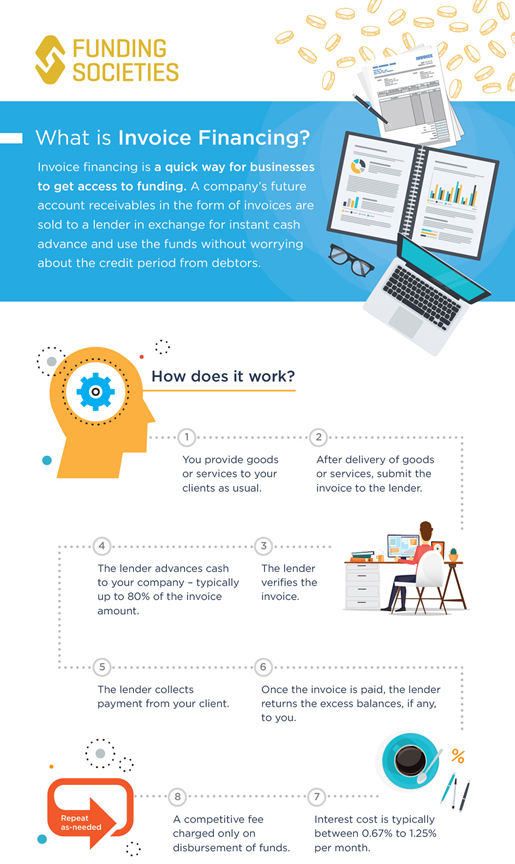
Here at Funding Societies, we can advance an immediate loan of up to 80% of the invoice value at interest rates as low as 0.67% a month. We charge no processing fee for the loan application and approval process, only a competitive fee upon successful disbursement.

For first time Funding Societies borrowers, it would take three to seven business days from application to disbursement – a process that is relatively quick and already includes a compliance check. Repeat borrowers are in luck: the assessment, approval, and disbursement process takes merely one to two business days.

Interested in learning more about our invoice financing product? Refer to our infographic below, or contact us to find out more!